Visiting the Udvar-Hazy Center: What You Need to Know + What You Can’t Miss
or as long as I can remember, I have always been fascinated by military aircraft. As a kid I watched movies like Top Gun, flew flight simulators, sketched jets in notepads and read flight manuals. I had my career all planned out...I was going to join the Air Force as a pilot, then apply for the space program and fly shuttle missions. Unfortunately, by high school I knew those dreams were likely not going to happen. While my eyesight was correctable, my allergies were not. "Generally speaking, pilot candidates must have no history of hay fever, asthma or allergies after age 12."

Growing up in mainly tropical places during my early childhood, I never had any allergies. But when I was in my early teens we moved to Scotland and that set off hay fever and seasonal allergies I suffer with to this day. Every year nature tries to kill me. So instead, I studied engineering in college and get my thrills by attending every air show I can, visiting every air and space museum I find and dream that one day I will have the opportunity to fly as a guest with either the Blue Angels or Air Force Thunderbirds. Which is why I’m incredibly lucky to have one of my favorite aviation museums practically in my backyard: the Steven F. Udvar-Hazy Center here in Chantilly, Virginia, near Washington Dulles International Airport.
Udvar Hazy At A Glance
📍 Location: Chantilly, Virginia 🎟 Admission: Free 🚗 Parking: $15; free after 4 p.m. 🕙 Hours: 10 a.m.–5:30 p.m. ⏱ My recommended time: 3–4 hours 🎫 Timed ticket required? No 🍔 Food: Shake Shack
An extension of the National Air and Space Museum in Washington, DC, the Udvar Hazy center is made up of two hangars – Boeing Aviation Hangar and the James S. McDonnell Space Hangar – that together have over 200 aircraft and spacecraft on display, as well as and many historical artifacts from the early days of aviation, the space program, commercial and military aviation and more. No matter how many times I go, I never get bored! There is so much to see you can easily spend a couple of hours or more. In this guide, I’ll show you my must-see aircraft, the areas of the museum you shouldn’t skip, how long you need, where to park and a few tips I’ve learned from visiting multiple times.
The Best of The Boeing Aviation Hangar
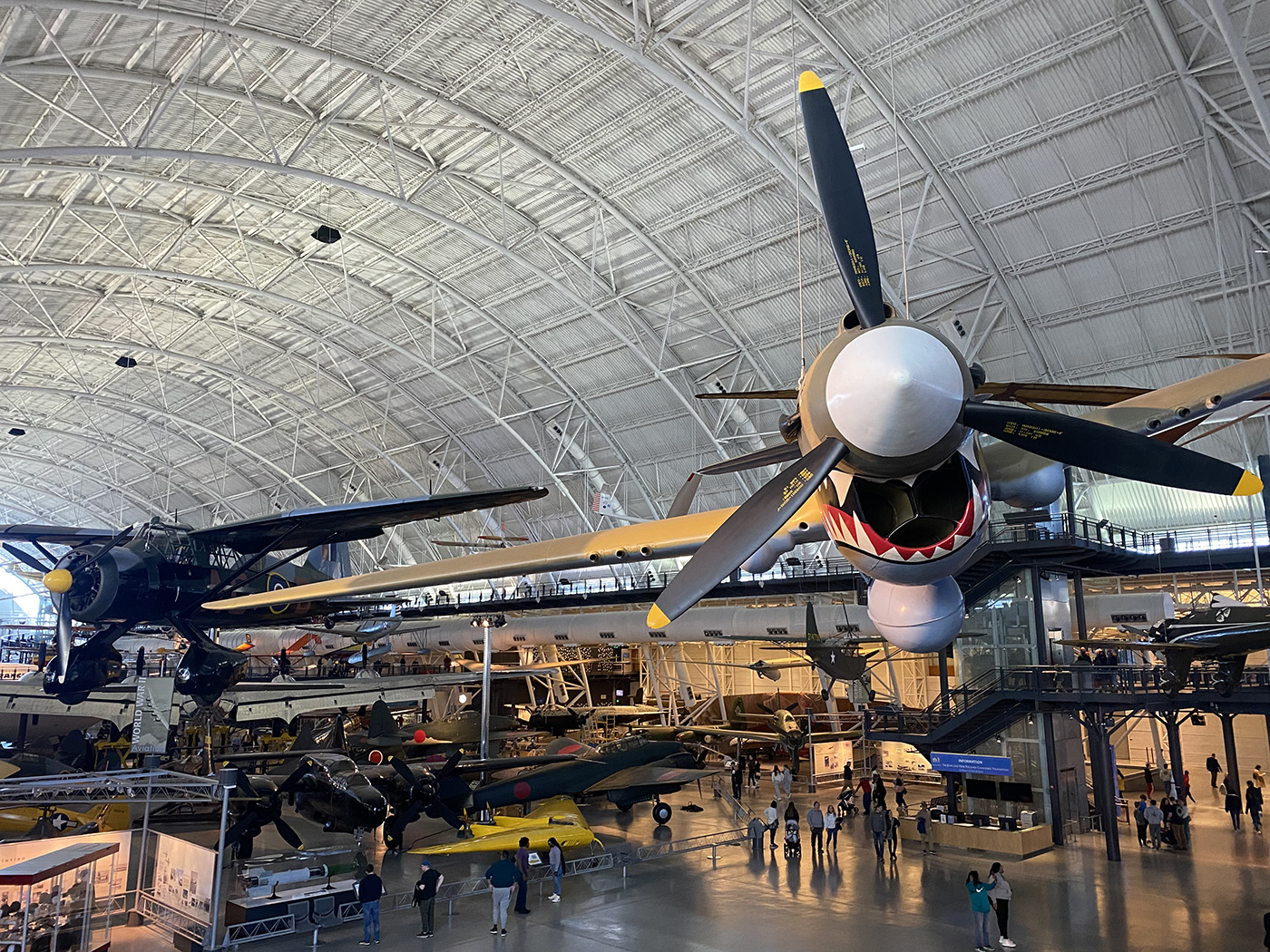
Like I said, there is so much to see within the center, but I will be kind to all my readers and just show you my favorites – which is still a lot! Visitors enter the museum through the Boeing Avation Hanger, which is filled with aircraft from the early days of flight to military aircraft to commercial aircraft. I immediately make my way to the first overlook. Looking right and left you see planes both on the ground and suspended from the ceiling. In fact, one really awesome features of the museum is all of the walkways and overlooks throughout that give you a spectacular overview of all the aircraft.
The SR-71 BlackBird
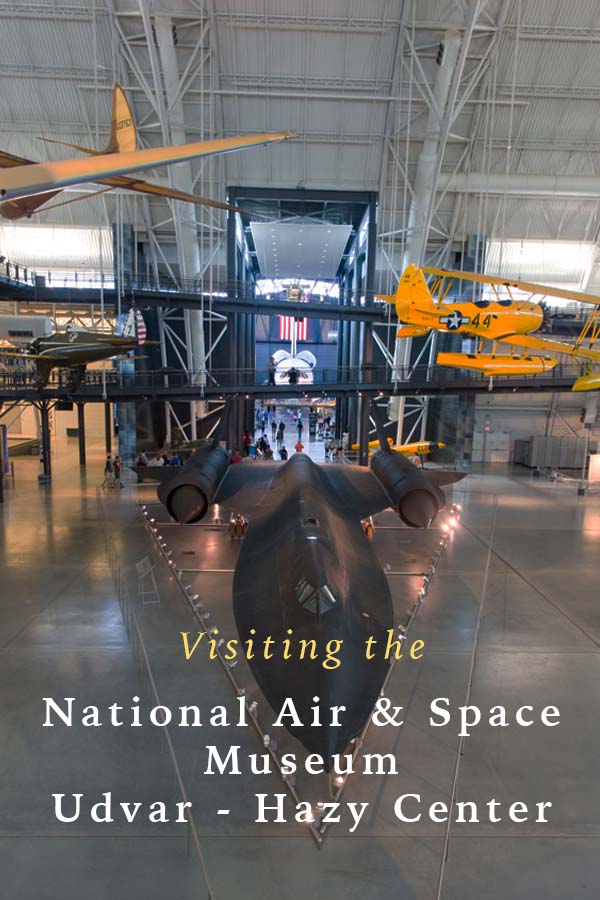
But anywho…looking down from the first overlook you see my favorite aircraft in the entire museum…the SR-71 Blackbird!
The SR-71 Blackbird was developed in the 1960s by Lockheed’s secretive Skunk Works division for high-altitude reconnaissance missions over hostile territory. Rather than relying on weapons for protection, the Blackbird relied on something much harder for an enemy to overcome: speed and altitude. The SR-71 could fly at more than Mach 3 (over 2,000 mph) and operate at altitudes above 85,000 feet (roughly 16 miles above the Earth). Flying that high and fast created extreme temperatures, so much of the aircraft was constructed from titanium.
But there was a problem: the United States didn’t have enough of the titanium needed to build the Blackbird. One of the world’s major sources? The Soviet Union – the very Cold War adversary the aircraft was being designed to spy on. So the CIA used a network of third parties and shell companies to secretly purchase Soviet titanium without revealing what it was for. In one of my favorite bits of Cold War irony, the Soviet Union unknowingly helped supply the material used to build the American spy plane designed to photograph its military activities from miles above.
The F-117 Nighthawk
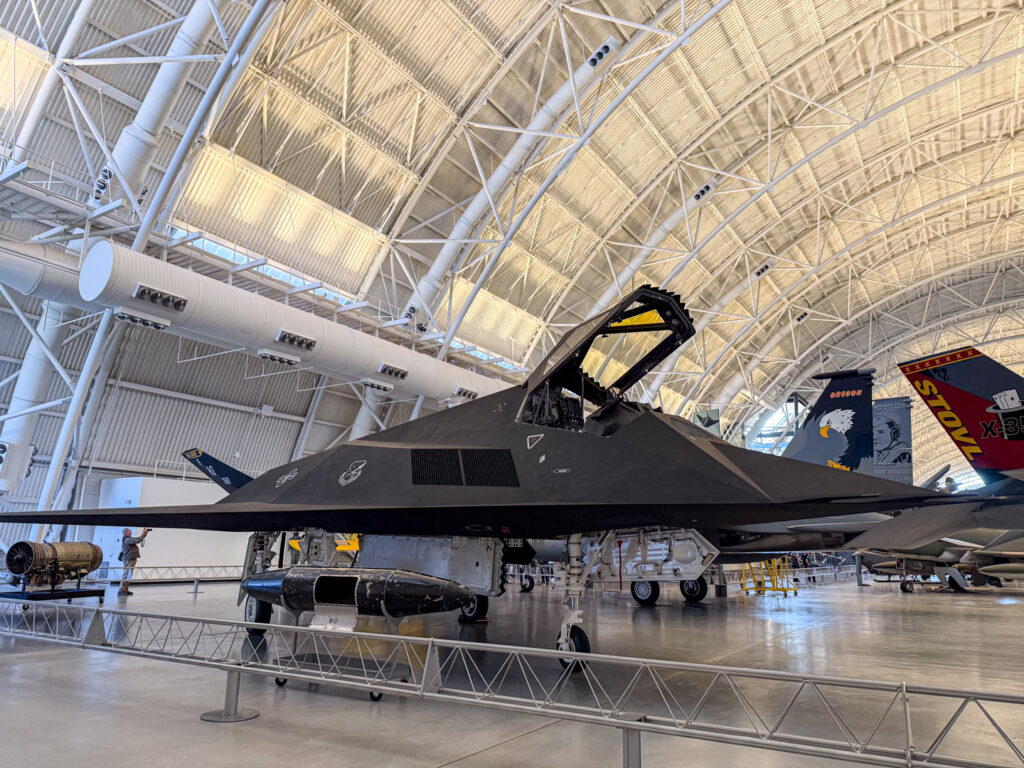
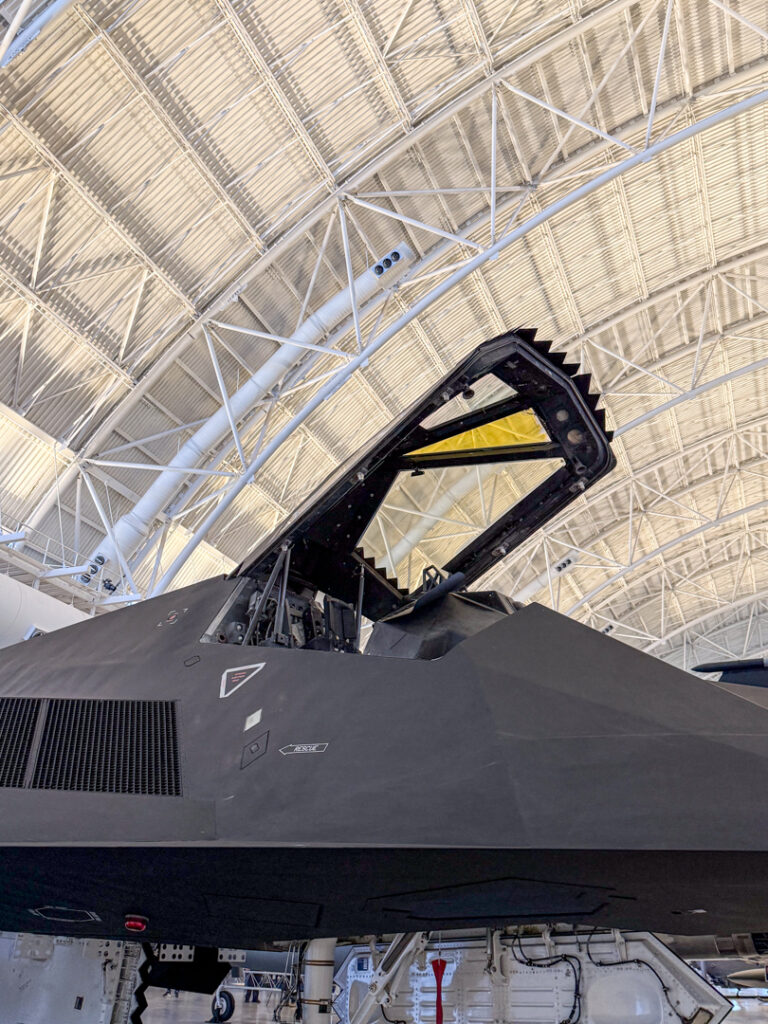
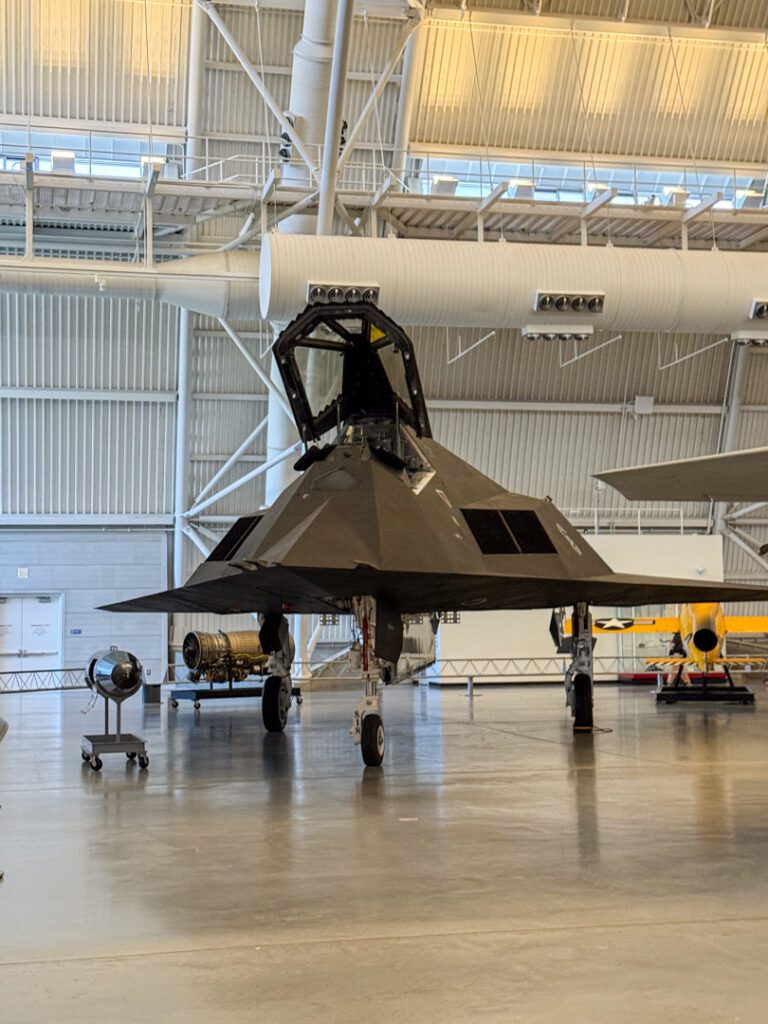
After I am done looking at the SR-71 Blackbird I make my way down the walkway along the right side of the hanger which has an interesting assortment of military aircraft. One of my absolute favorites in this section is Udvar’s newest resident – the F-117 Nighthawk!
Like the Blackbird, the Nighthawk was also produced by Lockheed’s Skunkworks. It was the first operational aircraft to be designed with stealth technology.
Pictures really don’t do it justice – it really is a beautiful aircraft that commands attention. And as someone who spent hours upon hours playing Microprose F-117 Nighthawk flight simulator as a teen, I was just so incredibly excited to see it!
Two of my other favorite jets are also nearby…the Blue Angels F/A-18 Hornet and the A-6 E Intruder.
The Enola Gay
On the other side of the SR-71 Blackbird you will find the WW2 aircraft section, including the Enola Gay, the B-29 Superfortress that dropped the atomic bomb on Hiroshima.
Standing beneath the Enola Gay is one of those museum experiences that forces you to stop for a moment. This is the B-29 that dropped the atomic bomb on Hiroshima on August 6, 1945, an event that killed tens of thousands of people immediately, contributed to Japan’s surrender and forever changed warfare and the world.It’s a humbling experience.
There’s also an impressive display German and American aircraft from WW2 around the Enola Gay.
The Concorde
After viewing all of the World War 2 planes, I move to the left side of the hanger that houses commercial and general aviation planes. With planes all around and even overhead it’s easy to get overwhelmed not knowing where to look first!
However, you definitely cannot miss the Concorde.
Flying across the Atlantic today takes at least 7 hours. Imagine doing it in less than half that time! For 27 years, the Concorde carried passengers across the Atlantic at around twice the speed of sound, cruising at altitudes of up to 60,000 feet – high enough that passengers could actually see the curvature of the Earth. A trip between New York and Europe that takes most of a day on a conventional airliner could take less than four hours aboard Concorde.
Out of 20 Concorde aircraft built, there are 18 left in the world and most of those are on display in museums around the world. Udvar-Hazy is only one of three museums in the United States where you can see a Concorde. The other two are the Museum of Flight in Seattle, Washington and the Intrepid Museum in New York City.
The James S Mcdonnell Space Hanger
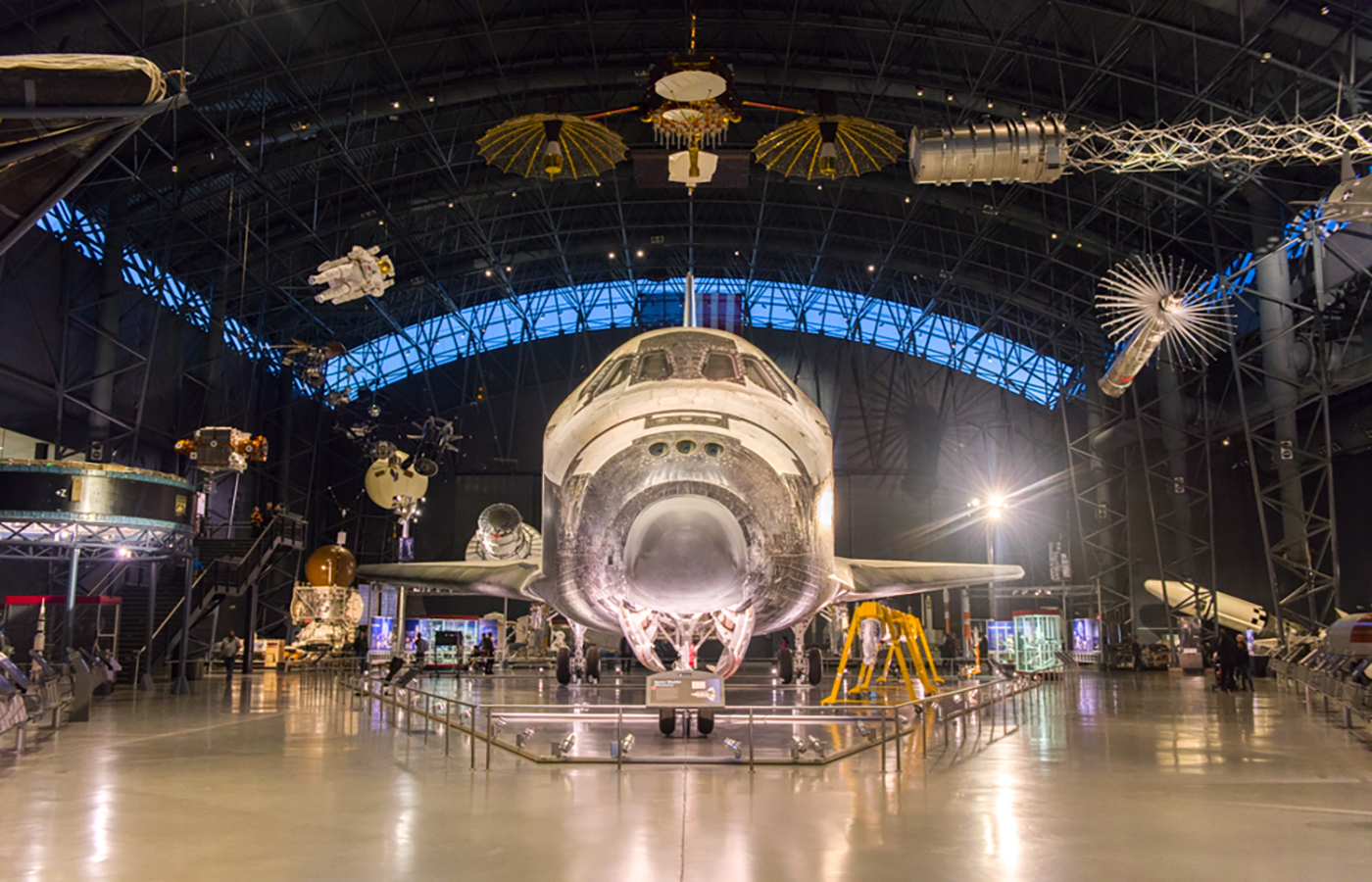
Once I am done looking at all the aircraft in the Boeing hangar, I head to the space hanger. If you love anything related to space, you will love this part of the museum. When you first enter the space hanger, you are taken back by how much is packed into this hanger. There are some incredible exhibits in here, including many from the Apollo missions. There is even the airstream trailer that the Apollo 11 astronauts stayed in during their quarantine period after returning from the moon. But obviously the main attraction is the Space Shuttle Discovery.
For someone like me that loves all things space-related, it’s so awesome to see the shuttle in person. It’s not a movie prop or replica, it’s the real deal!
Mary Baker Engen Restoration Hangar
Another amazing area of Udvar Hazy that sets it apart from other museums is the restoration hanger, where you can see what aircraft and other artifacts are being repaired or restored. If you visit during the week chances are you will most likely see museum staff working on a number of projects.
We’ve been fortunate to see the restoration of a few aircraft from start to finish that are now on display in the museum…
along with a full-size X-Wing Starfighter movie prop on loan from Lucas Films that is now on display at the Smithsonian Air & Space Museum in Washington, DC. This was a fun surprise for me since I am an avid Star Wars fan.
Donald D. Engen Observation Tower
One part of the museum you won’t want to miss is the observation tower. Located near the Imax Theater and accessible by an elevator, the tower has an exhibit explaining the workings of an airport and air traffic control tower and gives you a 360-degree view of planes flying in and out of Dulles International Airport. The amount of air traffic you see depends on the time of day and weather conditions. Sometimes you are lucky and see a lot of activity, and other times there’s hardly anything to see. But no matter what, it’s a pretty cool experience for aviation fans! Now a really geeky thing to do is bring up a flight tracking app like FlightAware and track planes as they arrive!
Know Before You Go
- The museum is located at 14390 Air and Space Museum Parkway, Chantilly, VA
- Hours: Open daily (except for Christmas) from 10 a.m. – 5:30 p.m
- Cost: FREE!
- Parking: Lots of ample parking. Parking is $15 but free after 4:00pm.
- Tours: There are free guided tours throughout the day
- Food: There is a Shake Shack located in the museum. No outside food is allowed. There isn’t a picnic area outside either, so if you do bring your own food you’ll have to eat it at your car.
- Gift Shop: Of course there’s a gift shop, which I always visit and always walk out with a new book!
So there you have it, my favorite things to see at Udvar Hazy. It’s a large museum, so while it is possible to do a quick tour in about two hours, I suggest setting aside at least 3-4 hours to really take everything in (and more if you want to see an IMAX show). I also suggest following their social media accounts as there’s always special events happening at the museum.
Planning a visit? Save this guide for later, and follow Jacki Goes Places on Facebook, Instagram and TikTok for more aviation museums, history-filled day trips and places where you can experience history for yourself.
Love Aviation History?
If you’re anything like me, one aviation museum is never enough! Check out these other aviation museums I’ve explored across the country!


Pingback: The Top 5 Aviation Museums Across the United States - Jacki Goes Places
Pingback: Stepping Aboard History: Touring the B-17 Sentimental Journey at the Warrenton-Fauquier Airport - Jacki Goes Places