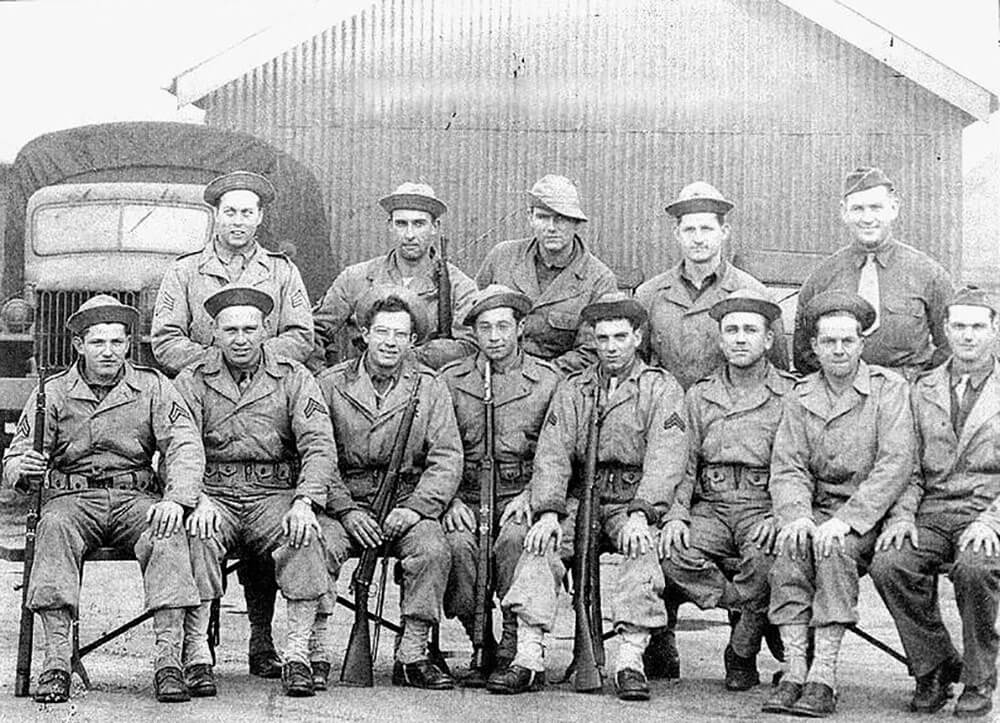
It was just after 8 a.m. on Monday, July 17, 1944. Twenty-one year old Elizabeth Teass, a Western Union clerk in Bedford, Virginia, was operating a Teletype machine near the back of Green’s Drug Store when the first telegraph came through.
Up until that day, Elizabeth was accustomed to receiving about one telegraph a week informing families in the Bedford area that one of their sons, brothers or husbands were missing or killed in action. That day alone, she would receive 11.
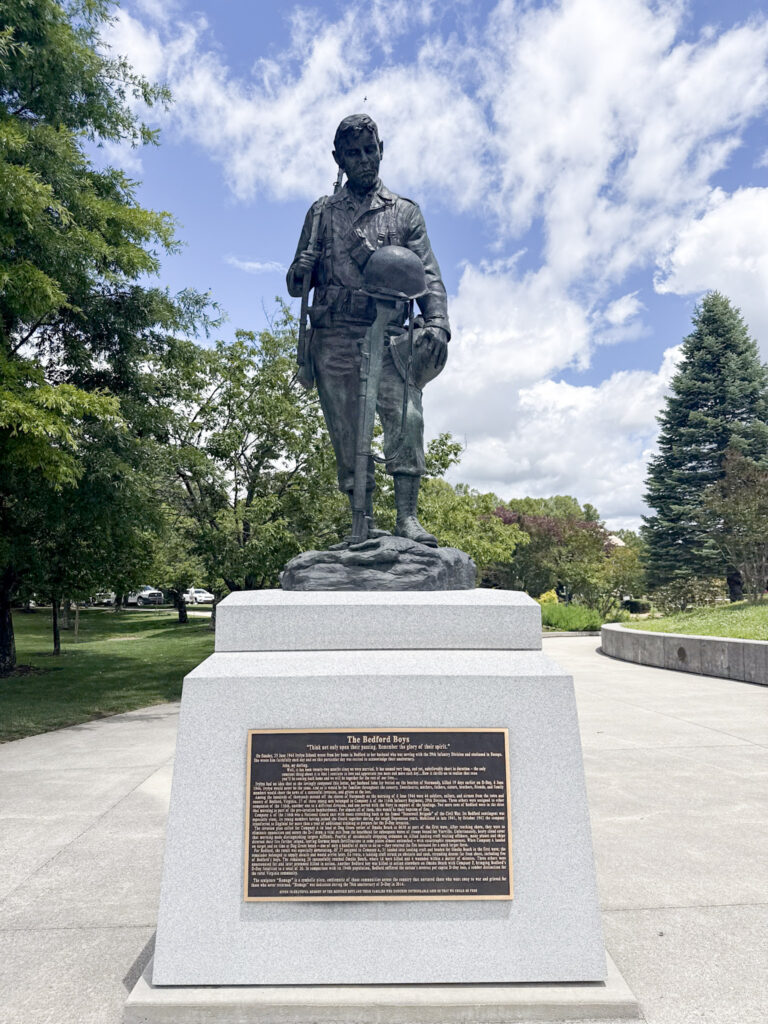
At the beginning of the war, Bedford was a close-knit community of 3,200 people in the Shenandoah Valley. Out of the roughly 156,000 Allied forces that landed on beaches of Normandy on the morning of June 6, 1944, 44 soldiers, sailors and airmen were from Bedford. Over time the town would learn that twenty of those died that day. This meant that Bedford lost more young men proportionally during the D-Day invasion of Normandy than any other American community across the United States.
To put it in perspective, if New York City (with a population of about 7.5 million in 1944) had suffered the same proportional casualty loss, New York City would have lost about 45,000 men that day. That’s a sobering thought.
In total, Bedford would lose over 100 men during WWII.
A Brief History of the Memorial
The idea for a National D-Day Memorial came from World War 2 veteran Bob Slaughter of Roanoke, Virginia. As the years went on after the war he noticed that there was little knowledge of what took place on D-Day and worried his fellow brothers-in-arms who died that day would be forgotten. He and other like-minded veterans formed a committee in 1989 with the goal of creating a national D-Day monument somewhere in the United States.
Finally, in 1996 Congress and then President Bill Clinton agreed. Because Bedford’s loss on D-Day was so unconscionable the town was chosen as the site of the memorial. The city of donated over 50 acres of land up on a hill with beautiful views of the surrounding mountains. Even though it would be a national monument, it would receive no federal funding, allowing the foundation to bypass the typical lengthy bureaucratic processes required to build a federally managed and operated monument.
A famous WWII veteran by the name of Charles M. Schultz donated $1 million and served as national campaign chair. Hundreds gathered in 1997 for the ground-breaking ceremony. The memorial would be built on “hallowed ground” with a consecrated mixture of local Bedford soil and sand imported from the coast of Normandy. Finally, on June 6, 2001, Bob Slaughter stood beside then President George W. Bush as the President accepted the memorial on behalf of the American people.
Visiting the Monument Today
This past June my parents invited us to join them at a lake house they were renting at Smith Mountain Lake, and on the way home my daughter Emma and I decided to make a stop at the National D-Day Memorial in Bedford. The memorial had always been in the back of my mind to visit, but since it’s a good three hour drive from our home, it just always seemed a bit too far for a day trip.
However, after our visit to the D-Day landing beaches in Normandy a few years ago, I was especially motivated to making a visit to the memorial a priority.
The night before our departure a strong storm rolled through the valley and dumped quite a lot of rain. When we woke up the next morning it was still raining and it looked like we would have to cancel our side trip to the memorial. This reminded me of what happened back in June of 1944. Originally, the D-Day invasion was scheduled for June 5, 1944. However, British meteorologists said the weather would not permit a successful invasion. General Eisenhower, Supreme Commander of the Allied Expeditionary Forces, trusted the meteorologists and postponed the invasion until June 6.
After packing up our car and saying goodbye to my parents, we began our journey home. By the time we reached Bedford, about a 40-minute drive, the skies began clearing so we decided to take a chance and stop at the memorial.
After parking we saw a large tour group just beginning a tour. Even though each paid admission includes a complimentary guided walking tour, I chose to walk through the monument alone, so I could spend my time and really take it all in. Perhaps on my next visit I’ll take the walking tour. If you decide to skip the group tour, make sure you download the app!
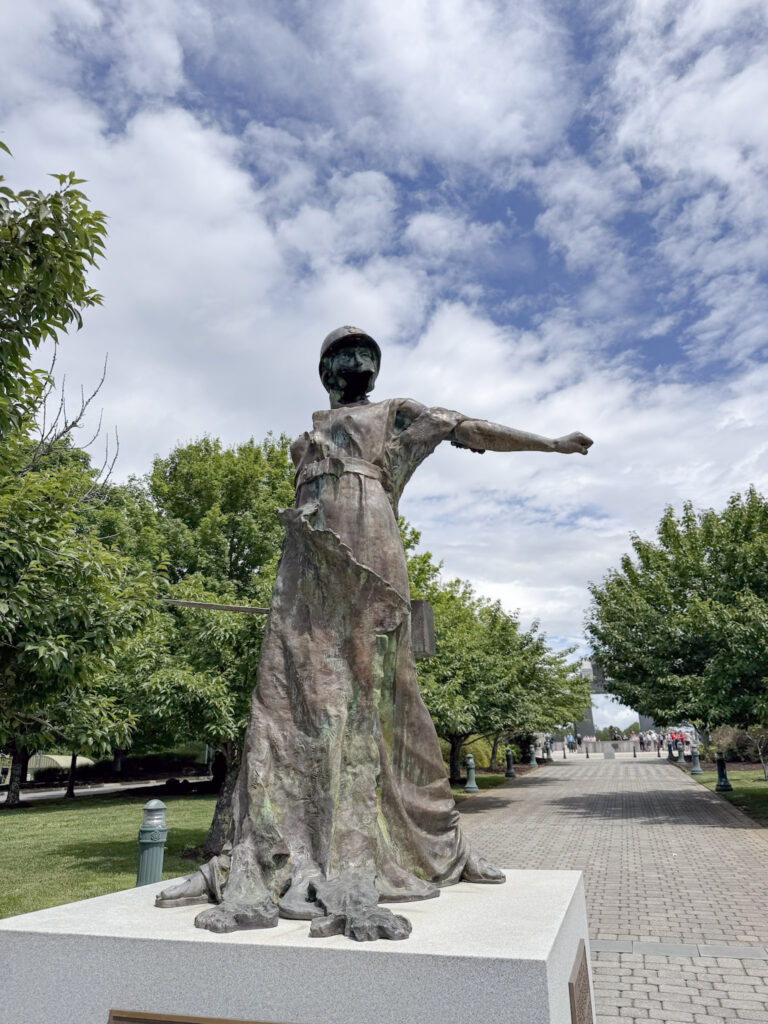
Instead of just standing around waiting for them to get a little ahead of us, we looked around and saw a short path that led to an interesting sculpture I knew absolutely nothing about. At first I was very confused, because on three sides of the statue the plaques were in French. Emma roughly translated a bit for me, but her conversational French skills only went so far. Then we found a fourth plaque written in English. Turns out it has quite an interesting story.
This sculpture is a replica of the French World War I monument known as La Dame de Trévières.
The original bronze victory statue, by Edmond de Laheudrie, was erected in 1921 in the village of Trévières, France to honor local men who died in World War I.
During the D-Day operation in June 1944, an exploding bomb sent from Omaha Beach took out most of her face. In the aftermath of the liberation of the town, it was decided that the statue would not be repaired. Instead, it would serve as a haunting reminder of the ravages and high cost of both World Wars.
Fast forward to 1994. That year, American veterans from World War II came back to Normandy for the 50th anniversary of D-Day. Some came across the statue and her story. She became quite popular among veterans and over the years they kept returning to visit her.
In 2000, requests were made to the town council to sell or donate the statue to the National D-Day Memorial. Not wanting to part with the original, the town council agreed to make an exact replica of the statue and gift that to the memorial. Here she pays tribute to the American soldiers who participated in the D-Day landings and particularly to the men of Bedford.
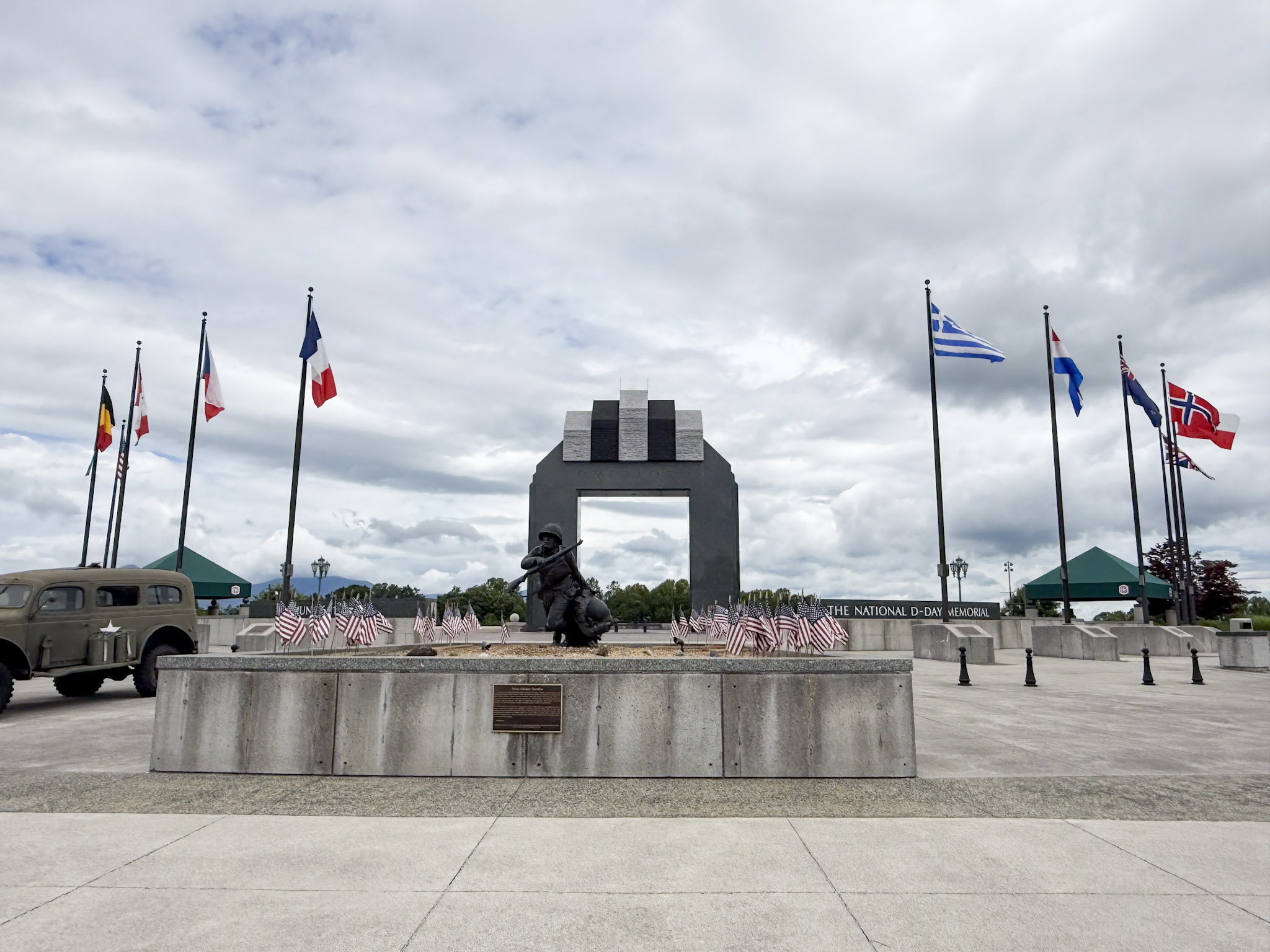
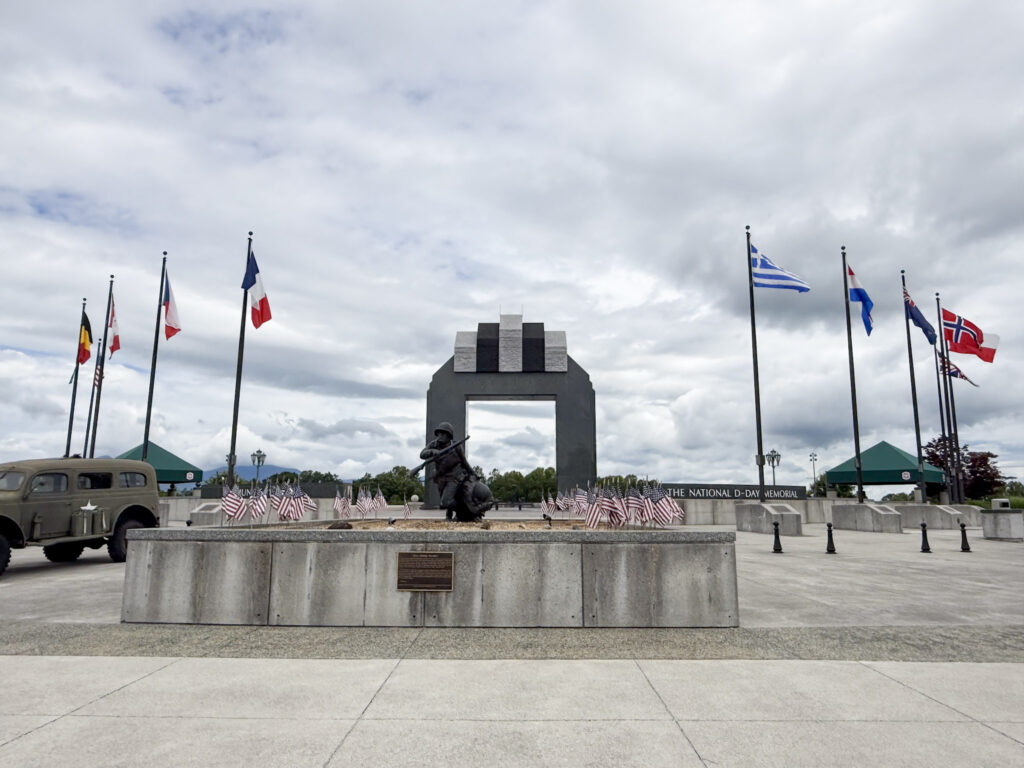
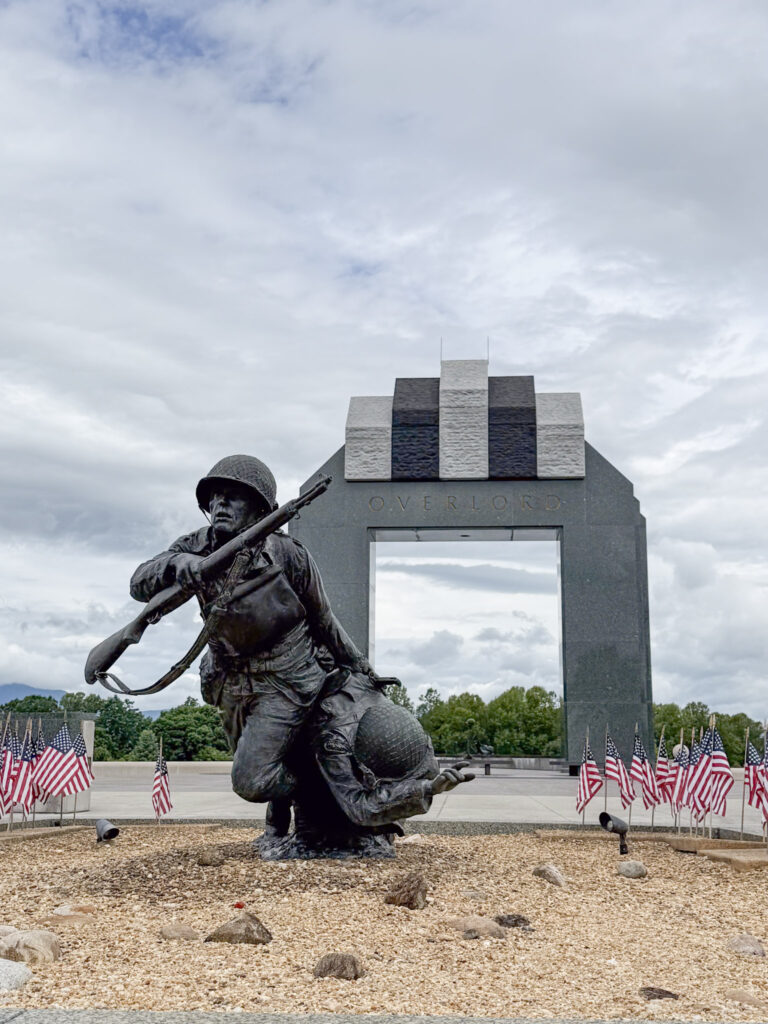
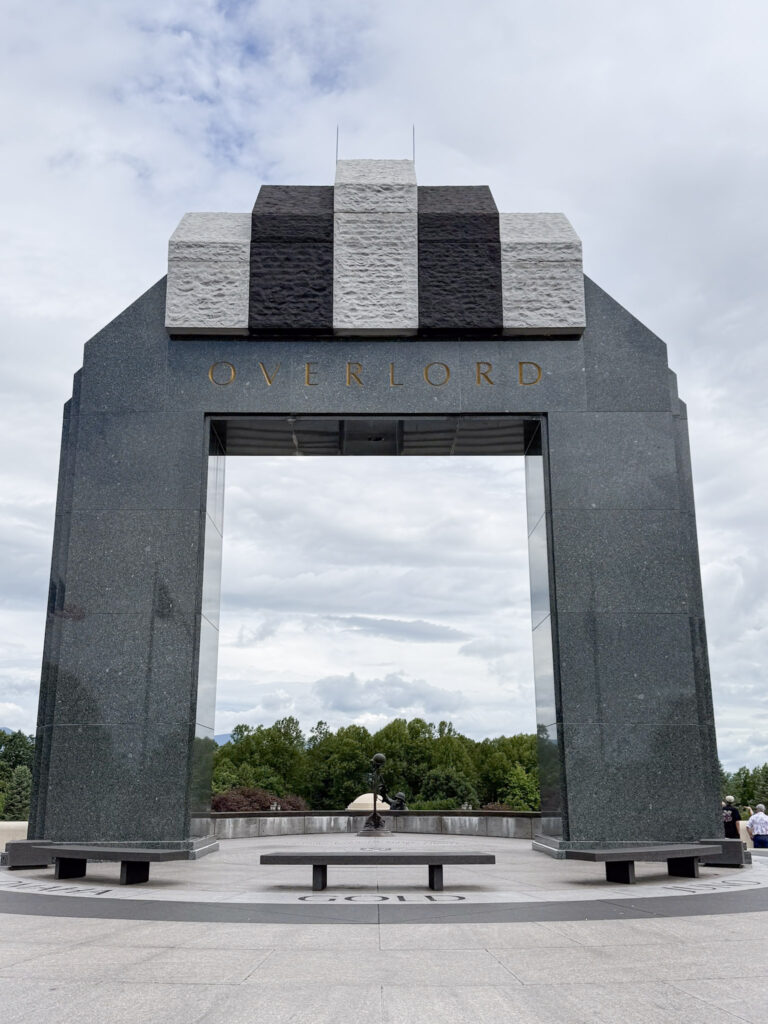
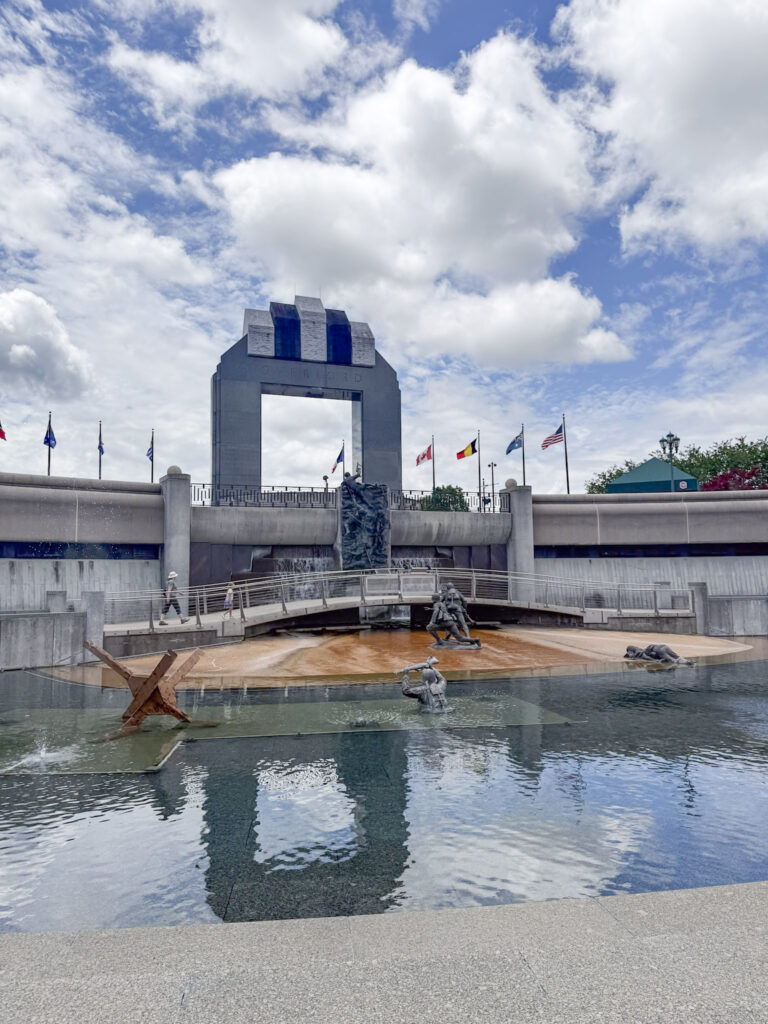
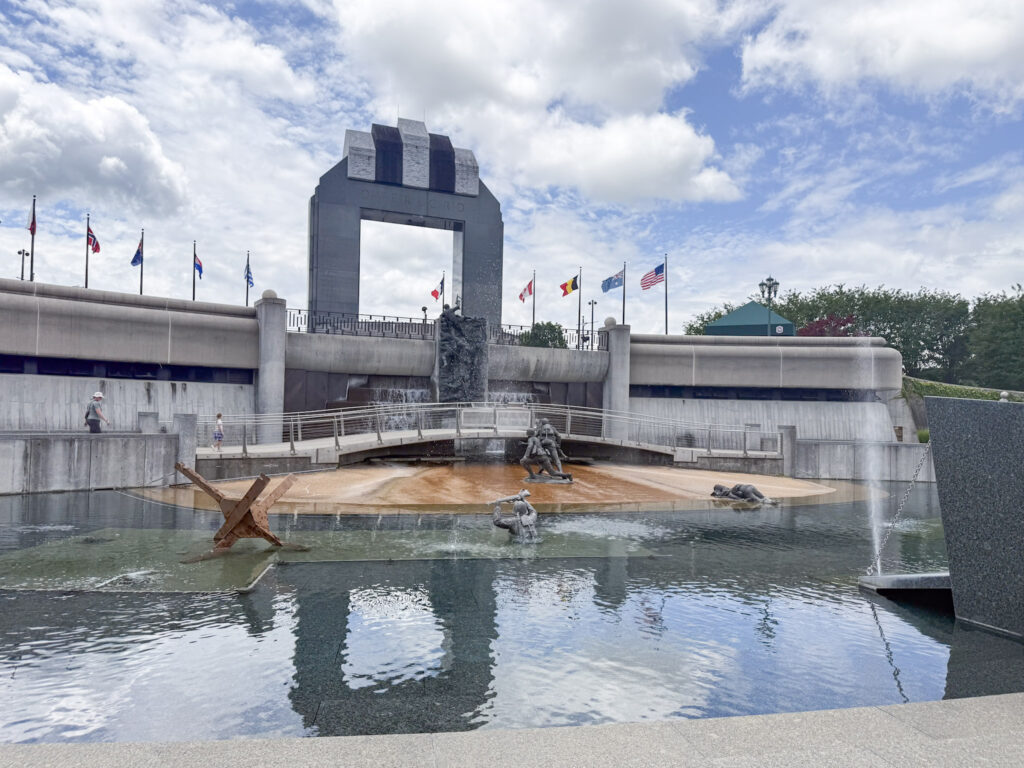
Then it was time to walk through the memorial. There are at least twenty areas to visit at the National D-Day Memorial, all with a significant message. For the sake of time I will just highlight my favorites. My first stop was the Robey W. Estes, Sr. Plaza and the Overlord Arch. The codename for the operation, Operation Overlord, is, still today, the largest air, land and sea operation ever undertaken. The arch’s size of 44 feet 6 inches coincides with the year 1944 and the 6 represents both the month of June and the date of the operation. The black and white stripes represent the alternating stripes that made Allied Aircraft easily identifiable. On either side of the memorial are the flags of the United States and the other 12 allied nations, arranged in alphabetical order.
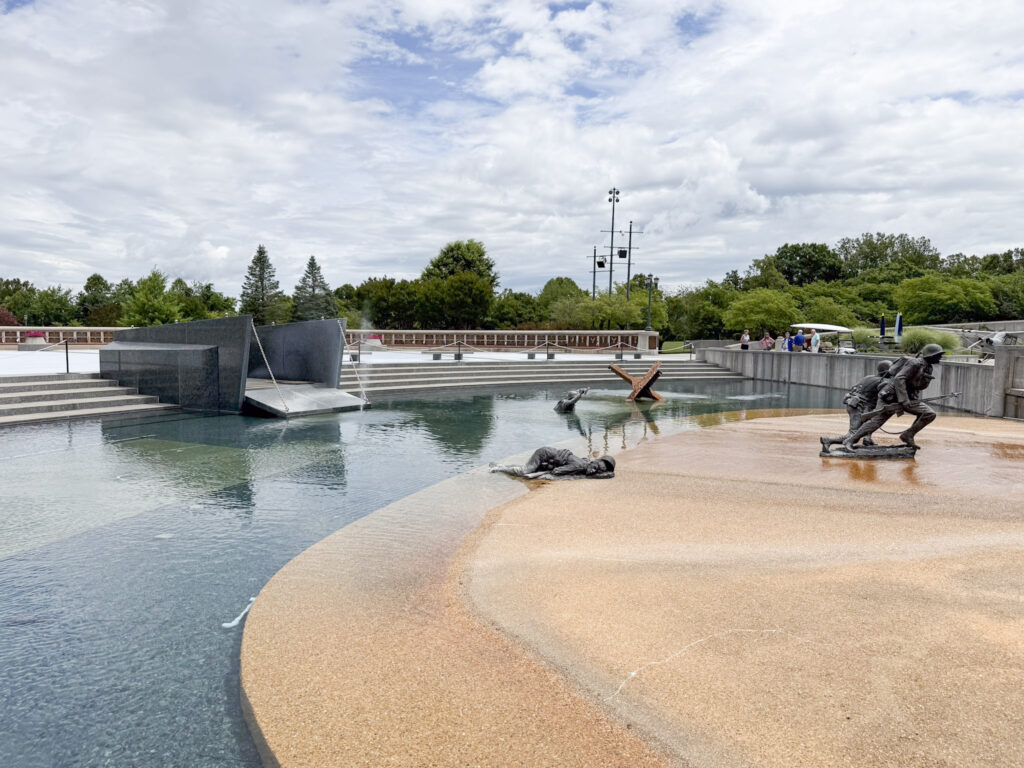
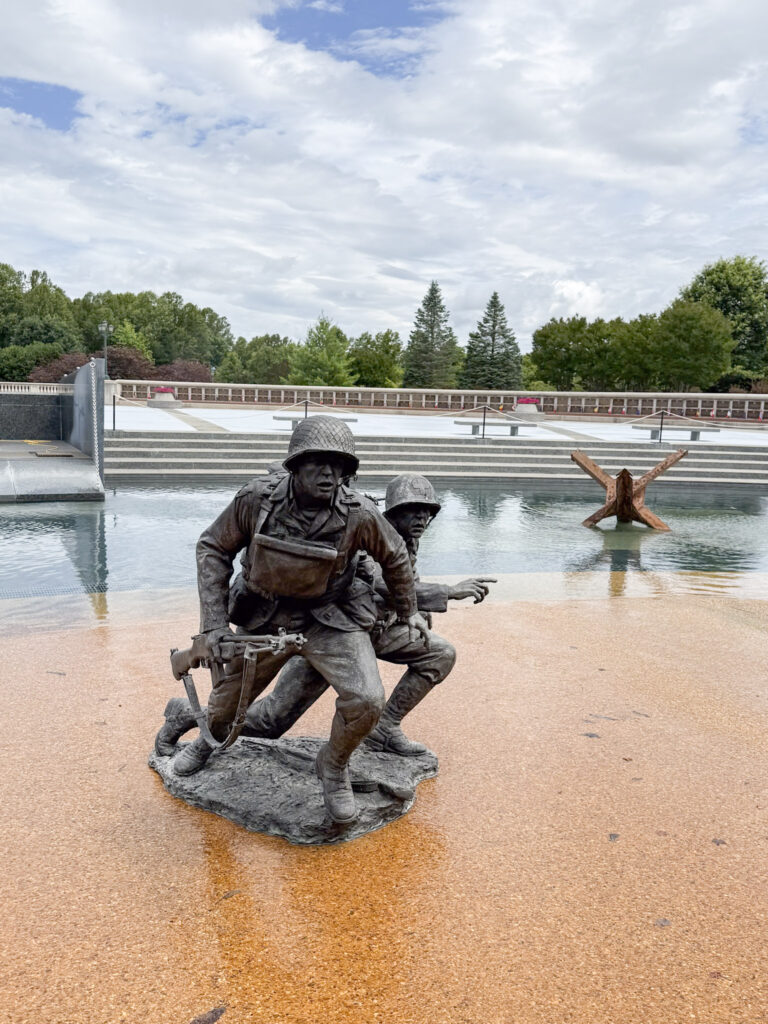
Beyond the arch and down some steps was the Beach Tableau. This was the most moving section of the memorial in my opinion, with the four sculptures of soldiers as they moved from the Higgins Boat, through the water, and up the shores of the beach. Sporadic bursts of water throughout the scene represent the gunfire the soldiers faced as they approached the shore.
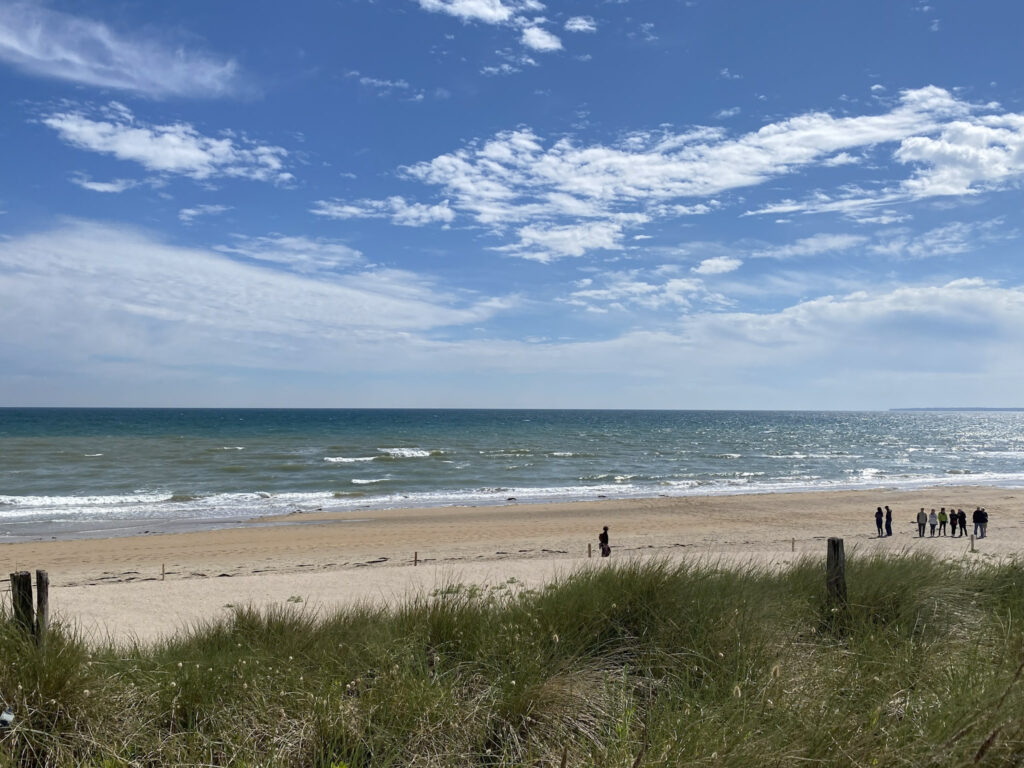
I spent a lot of time here, taking in both the sights and the sounds. The longer I stood there, the more my mind went back to our visit to the beaches of Normandy and what I felt standing there.
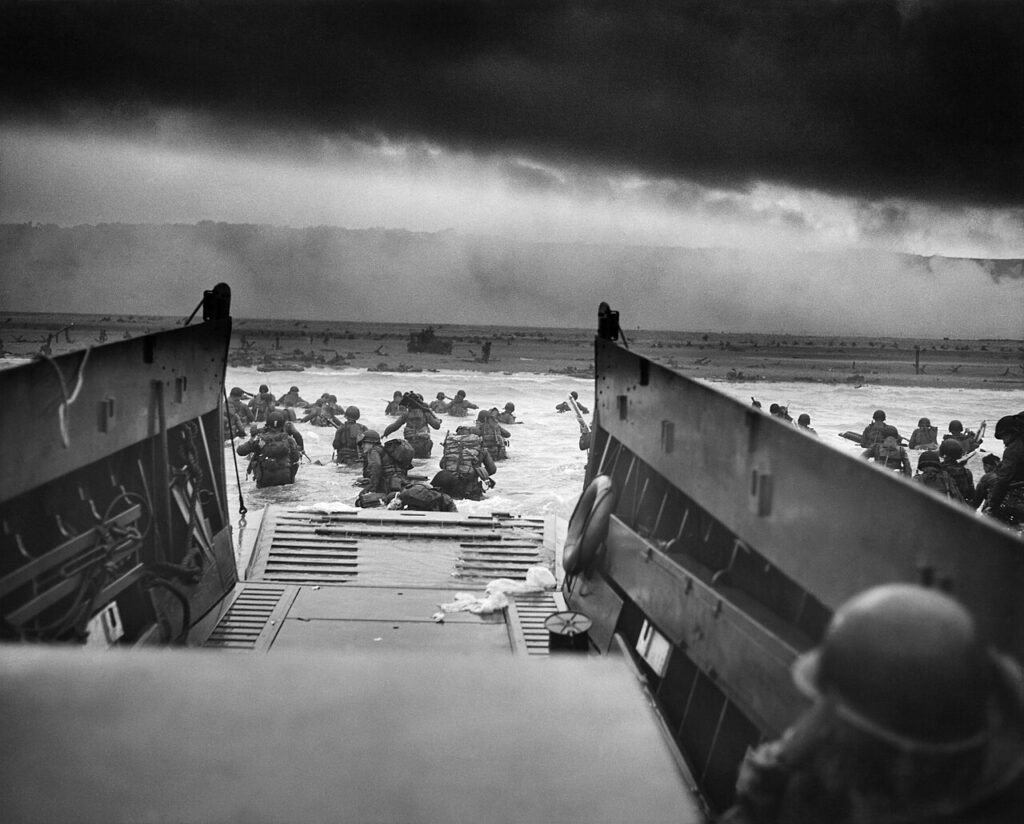
Standing there on the beach in France, it was hard to imagine that just 78 years earlier, that quiet coastline was anything but quiet with 5,000 ships filling the water and 11,000 aircraft roaring overhead. When the boat ramps lowered, thousands of men spilled out into the churning water, most of them just our daughters age or maybe just a few years older. As they jumped with the rush forward, they swam then they slogged through the rough surf, fully dressed with up to 100 pounds of equipment on their backs. Many drowned before reaching shore, but for the ones who made it out of the water, that was the easy part.
Their orders were to head straight for the enemy fire and scramble up the cliffs after them. But first, they had to survive the 200 yards of beach before they reach the seawall for some bit of protection. As they crawled and ran across the beach, they did so under a hail of Nazi firepower. Land mines exploded around them. A heavy blanket of rapid machine gun-fire, artillery rounds, whizzing, pinging, exploding and blasting around them. The thunderous assault rained down from the cliffs over-head where the Nazis were embedded from the protection of concrete bunkers. Their friends falling and dying around them.
The Beach Tableau isn’t anything of the magnitude of what actually occurred on D-Day, but it’s just enough to bring a somber silence among those reflecting on the scene.
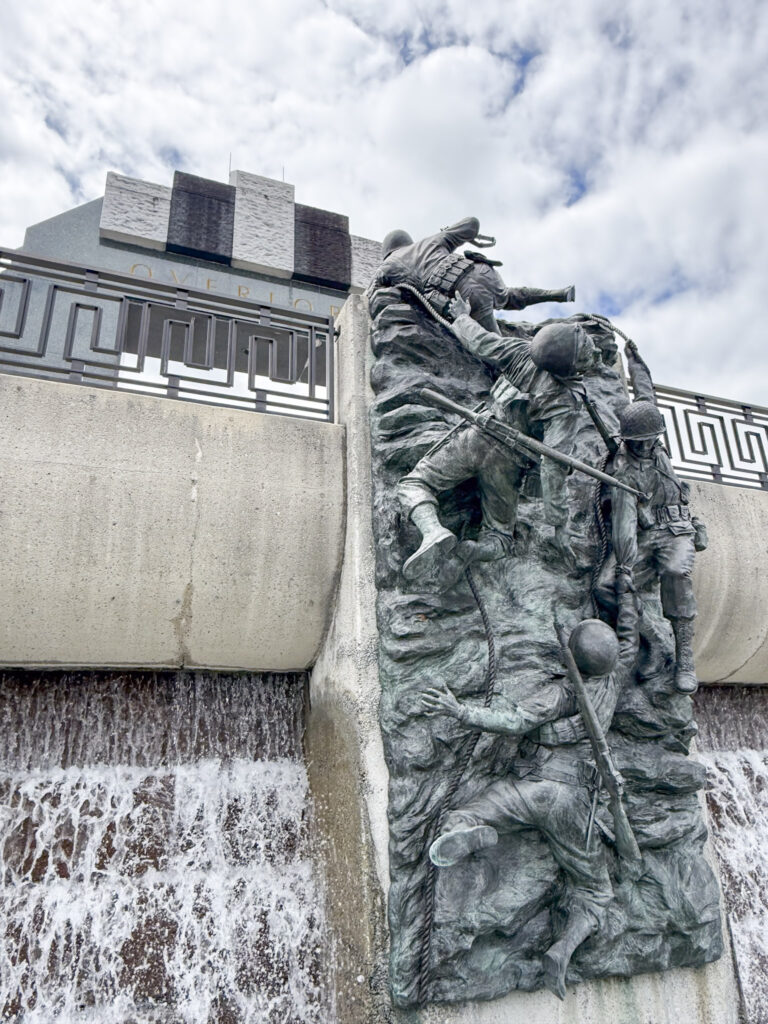
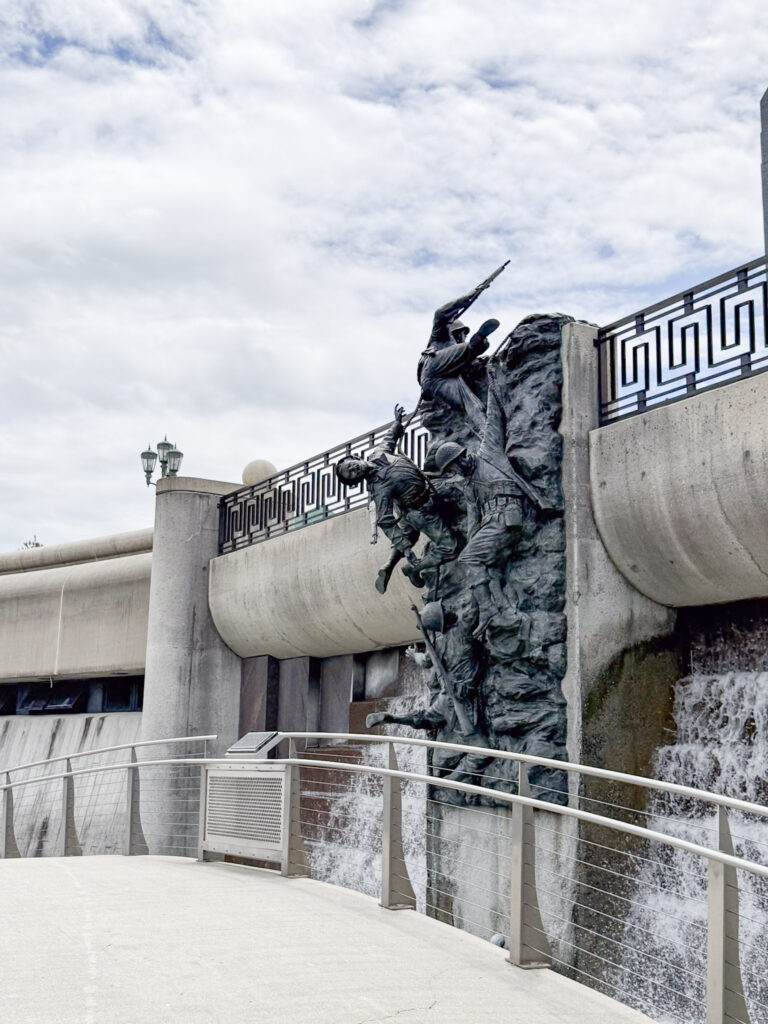
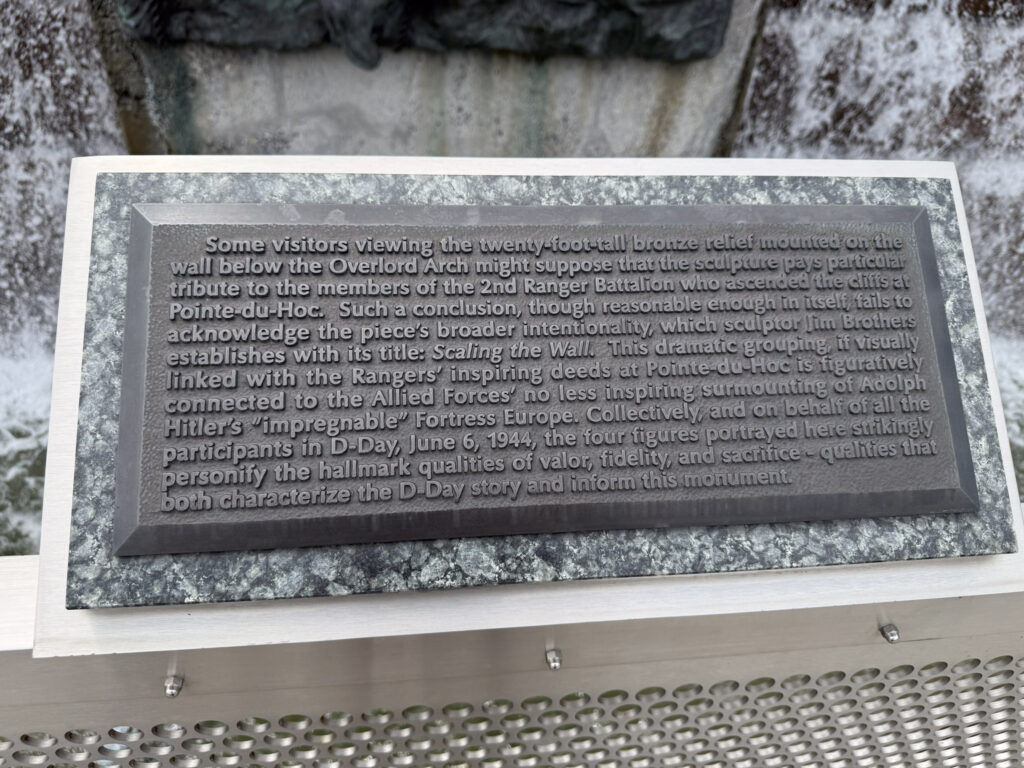
Next to this is another sculpture called Scaling the Wall, which dramatically depicts soldiers scaling a steep cliff face.
Before reading the plaque, I naturally assumed this paid tribute to the 2nd Ranger Battalion who scaled Pointe du Hoc (another place we had visited in France), but I was wrong. Instead, it represented Allies breaching Hitler’s “impregnable” Fortress Europe.
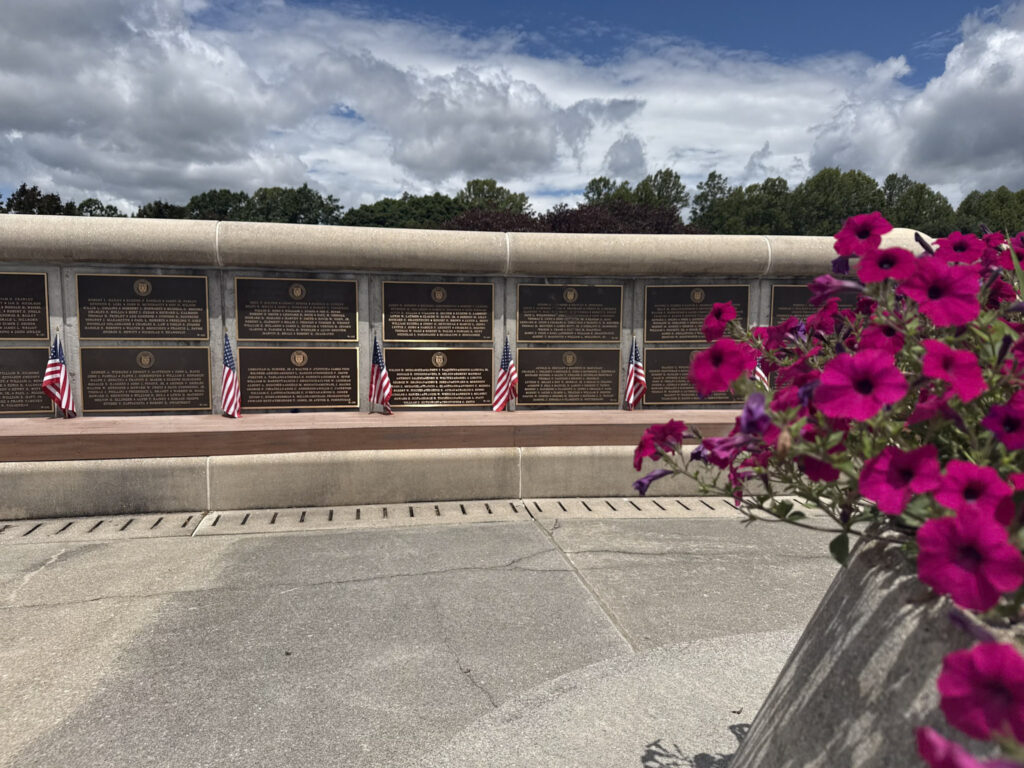
Surrounding the plaza behind the beach scene are the names of the 4,415 Allied service members killed in action on D-Day. The 2,502 Americans are listed on one side; the 1,913 Allies on the other. The plaza itself is split into five segments representing Utah, Omaha, Gold, Juno, and Sword.
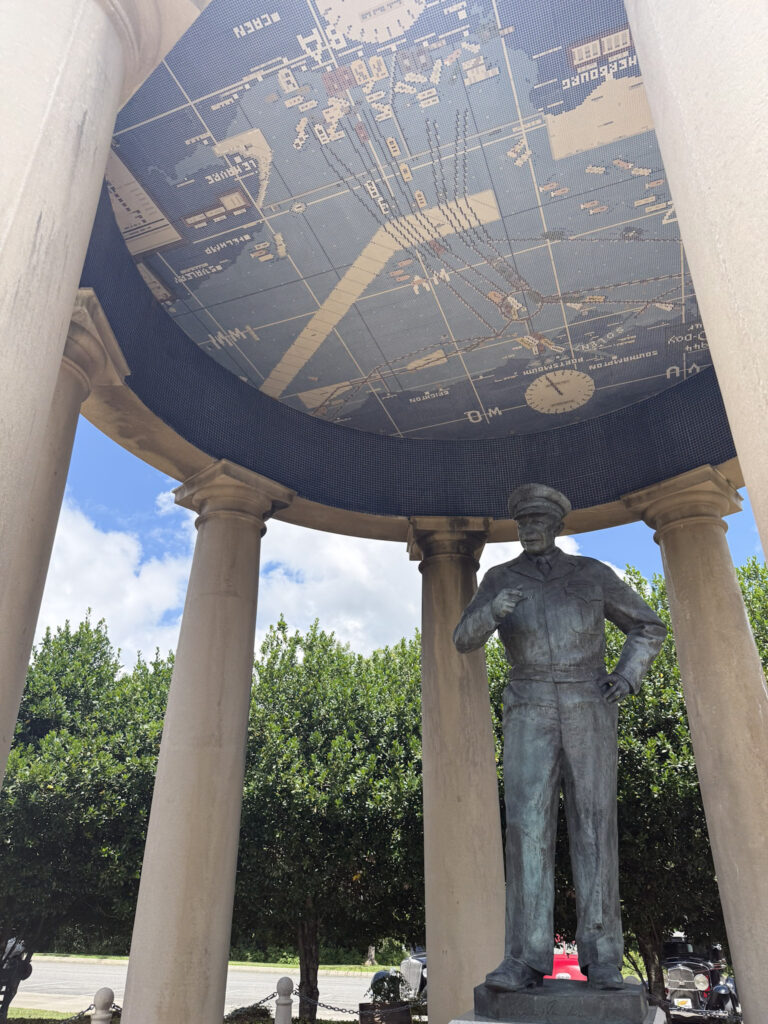
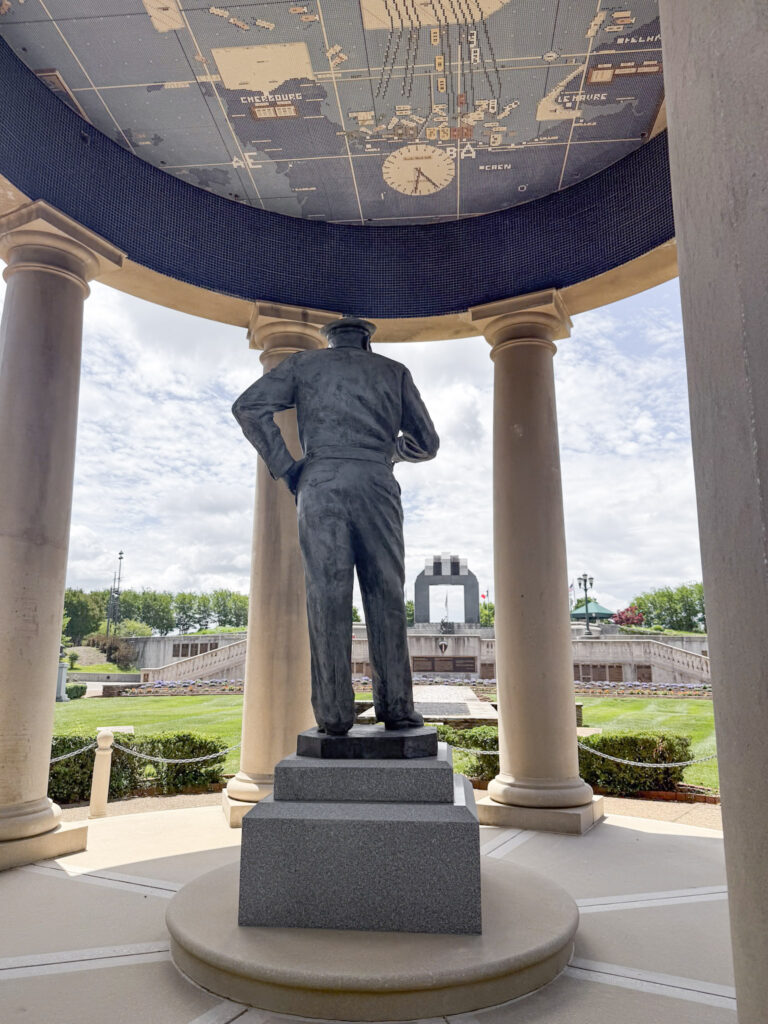
Towards the rear of the memorial in the English garden is a statue of the Supreme Commander of Operation Overlord, General Eisenhower. It is a beautiful, not only from the front but also the back.
On the ceiling is a tile mosaic of the operation plan.
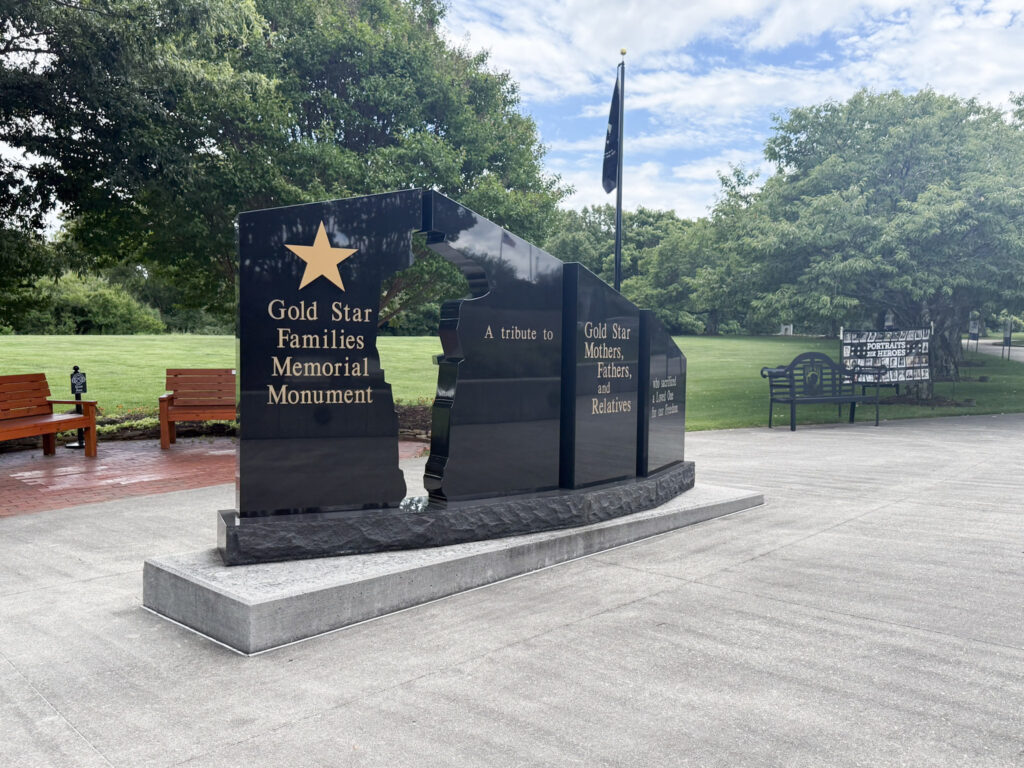
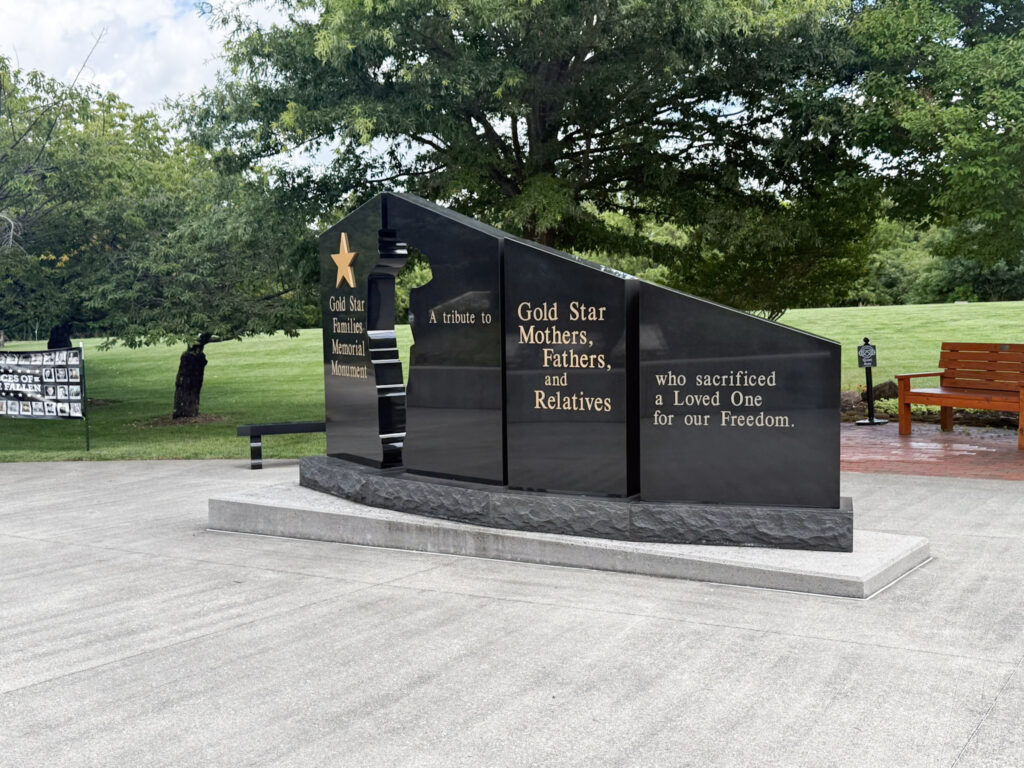
Another emotional and thought-provoking sculpture was the Gold Star Memorial Monument, recognizing the sacrifices of the families left behind when heroes pay the ultimate sacrifice.
As we finished our walk though the memorial and made our way to the gift shop (where every good tour ends!) I found one last memorial I had been looking for… tribute to the Bedford Boys.
Tickets: $15 per adult – includes guided walking tour; $10 per Veteran (not WWII); WWII Veterans/Active-duty Military – FREE; $10 per student (ages 6-18 or older with college ID; Under 6 – FREE
Hours: Open daily 10AM – 5PM. Closed on Mondays December – February. Closed on major holidays.
Food: There is no cafe or restaurant located at the memorial.
Want to Learn More About D-Day and the Bedford Boys?
If visiting the National D-Day Memorial leaves you wanting to dig deeper into the history of D-Day, I’ve put together a list of books I recommend.
Disclosure: I’m an affiliate of Bookshop.org, which means I may earn a small commission if you purchase a book through one of my links. The price you pay doesn’t change, and your purchase helps support independent bookstores.